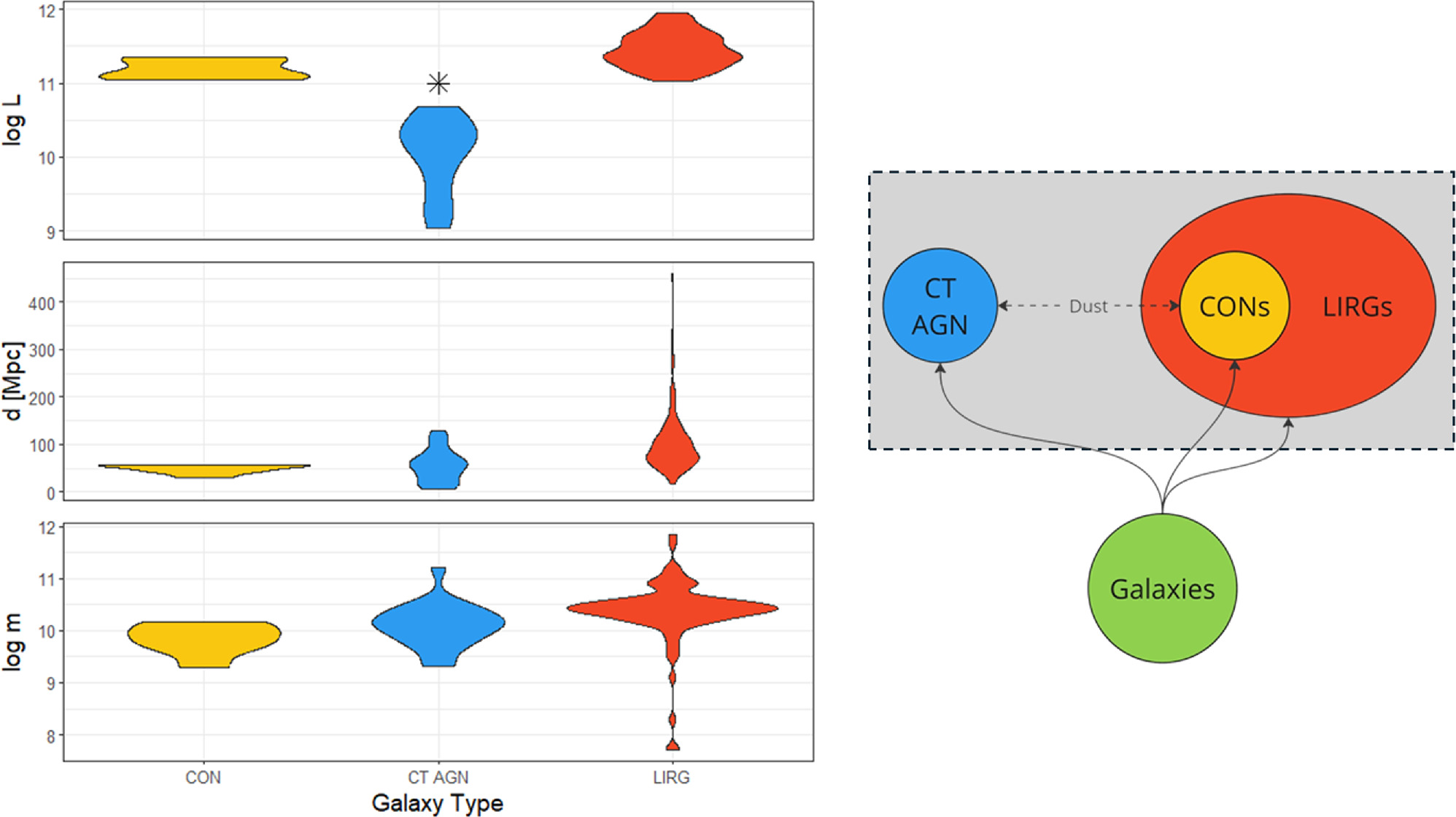
Luminosity sources in compact obscured nuclei (CONs) and the role of CONs in galaxy evolution are yet to be fully understood. We address these through an examination of luminosity and mass distributions of a sample of CONs in luminous infrared galaxies (CON-LIRGs), Compton thick active galactic nuclei (CT-AGN), and luminous infrared galaxies (LIRGs). We find LIRGs, CON-LIRGs, and CT-AGN occur in disk galaxies with similar stellar masses. CON-LIRGs and LIRGs, while potentially powered in different ways, have similar bolometric luminosities. Since these three unusual evolutionary phases occur in the same general population of galaxies, transitions between these evolutionary phases are possible within the same galaxy. However, CONs typically are substantially more luminous than CT-AGN, so evolution from a CT-AGN to a CON-LIRG would require additional luminosity from a compact starburst or increased central black hole accretion power. CON-LIRGs are not simply more deeply embedded versions of CT-AGNs.
Notes on Compact Obscured Nuclei. I. The Evolutionary Context
Python
R
Paper